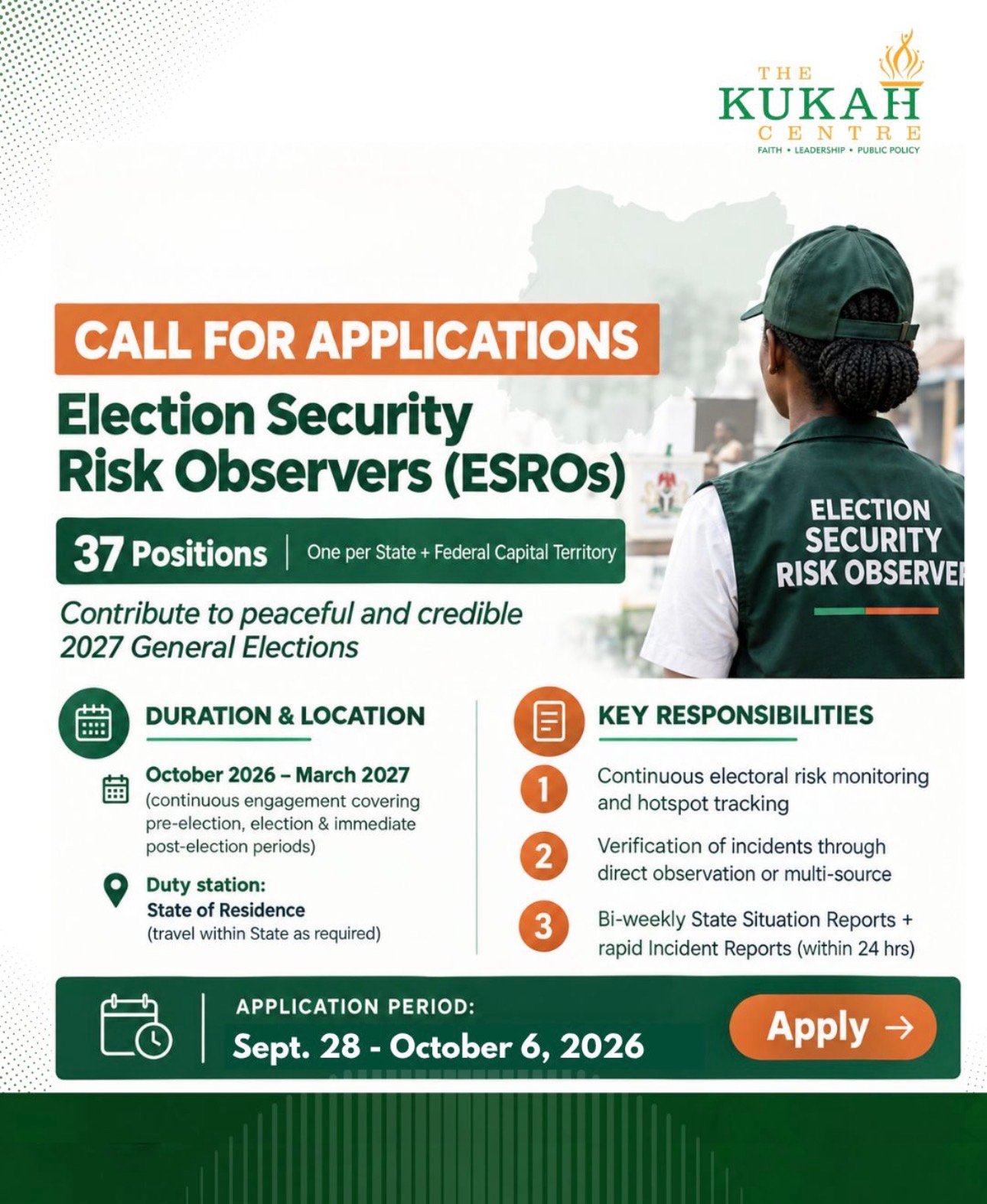
Apply to The Kukah Centre ELECTION SECURITY RISK OBSERVERS ESROs
CALL FOR APPLICATIONS
ELECTION SECURITY RISK OBSERVERS ESROs
THE KUKAH CENTRE
PROGRAMME: European Union Support to Democratic Governance in Nigeria EU-SDGN II
COMPONENT: Component 6a – Support to the National Peace Committee
POSITION: Election Security Risk Observer ESRO
LOCATION: One assigned State across Nigeria or the Federal Capital Territory FCT
DURATION: October 2026 to March 2027
ASSIGNMENT TYPE: Short-Term Expert
ABOUT THE PROGRAMME
The Kukah Centre, serving as the Secretariat of the National Peace Committee NPC, is implementing an intervention under the European Union Support to Democratic Governance in Nigeria EU-SDGN II Programme to strengthen electoral risk monitoring, early warning systems and coordinated preventive response mechanisms ahead of Nigeria’s 2027 General Elections.
The initiative will deploy Election Security Risk Observers across the 36 States and the Federal Capital Territory.
ESROs will provide verified, field-based information on electoral risks, political developments, security incidents and emerging threats. Their reports will support the Election Security Information ESI Hub in strengthening early warning analysis, incident verification, hotspot monitoring, risk mapping and preventive engagement with relevant electoral stakeholders.
PURPOSE OF THE ASSIGNMENT
The Election Security Risk Observer will support the National Peace Committee’s Electoral Risk Monitoring Framework through systematic field-based monitoring, verification and reporting of electoral developments within an assigned State.
The ESRO will monitor political developments and electoral tensions, identify emerging conflict triggers, document and verify election-related incidents, engage relevant stakeholders and provide timely, factual and evidence-based reports that contribute to the ESI Hub’s early warning and preventive response mechanisms.
KEY RESPONSIBILITIES
- ELECTORAL RISK MONITORING
Monitor political developments and electoral tensions within the assigned State.
Track emerging conflict drivers, electoral flashpoints and potential hotspots.
Identify and regularly update electoral hotspot locations.
Monitor campaign activities and political mobilisation.
Observe election-related security developments.
Monitor incidents involving violence, intimidation, hate speech, inflammatory rhetoric, vote buying, destruction of electoral materials, misinformation and other electoral offences.
Identify emerging trends that could affect peaceful elections.
Monitor stakeholder conduct against Peace Accord and relevant codes of conduct, including political parties, candidates and security agencies.
- STAKEHOLDER ENGAGEMENT
Maintain regular engagement with relevant stakeholders, including:
INEC State Offices
Nigeria Police Force
Nigeria Security and Civil Defence Corps NSCDC
Traditional leaders
Religious leaders
Political parties
Civil society organisations
Women’s groups
Youth organisations
Community leaders
Media practitioners
Engagement will support information gathering, report validation, incident verification, understanding of local dynamics and stronger contextual analysis.
- DATA COLLECTION AND REPORTING
Submit bi-weekly State Situation Reports every two weeks.
Submit Incident Reports within 24 hours of significant developments.
Include an expanded monthly risk rating and forward outlook in the second bi-weekly report of each month.
Use approved reporting templates and digital reporting platforms.
Provide supporting evidence where appropriate.
Ensure all reports are objective, factual, timely and evidence-based.
- VERIFICATION AND QUALITY ASSURANCE
Verify incidents through direct observation wherever possible.
Where direct observation is not possible, corroborate information using at least two credible sources.
Clearly distinguish between verified incidents, credible reports and unverified allegations.
Immediately escalate high-risk incidents requiring urgent attention to the assigned Regional Lead Analyst or, where the Regional Lead Analyst is unreachable, directly to the ESI Hub.
- COORDINATION
Participate in periodic coordination and review meetings.
Respond promptly to requests for clarification.
Work closely with the assigned Regional Lead Analyst, who will provide first-line supervision and quality assurance.
Support data verification exercises conducted by the ESI Hub.
Contribute relevant material and case examples to ESI Hub knowledge and communication products, including periodic podcasts, when requested.
DELIVERABLES
Each ESRO will be expected to submit approximately 13 scheduled knowledge products during the six-month assignment.
These include:
- Approximately 12 bi-weekly State Situation Reports covering hotspot status, stakeholder engagement, verified incident summaries, state risk ratings and stakeholder conduct.
- Incident Reports within 24 hours of significant incidents as they occur.
- One End-of-Assignment State Electoral Risk Assessment using the approved structured template.
The second bi-weekly report of each month will include an expanded monthly risk rating and forward outlook.
Across 37 ESROs, the programme anticipates approximately 481 scheduled submissions, in addition to event-driven Incident Reports.
The reports will serve as operational inputs to the ESI Hub’s central incident database, dashboard, hotspot and risk maps, trend analysis, early warning alerts and other electoral security analytical products.
REQUIRED QUALIFICATIONS
Bachelor’s degree in Political Science, Peace and Conflict Studies, Law, International Relations, Sociology, Security Studies, Journalism, Development Studies, Governance or a related discipline.
Minimum of 2 years’ experience in election observation, governance, conflict monitoring, peacebuilding, research, journalism, civil society programming or related fields.
Strong understanding of Nigeria’s electoral environment.
Knowledge of electoral conflict dynamics.
Experience using digital reporting platforms.
Strong writing and analytical skills.
KEY COMPETENCIES
Knowledge of the political and security environment of the assigned State.
Excellent analytical and report-writing skills.
Ability to objectively verify information.
Strong ethical standards.
Excellent interpersonal and stakeholder engagement skills.
Ability to work independently.
Ability to meet strict reporting deadlines.
Proficiency in Microsoft Office and mobile data collection applications.
ETHICAL REQUIREMENTS
Successful applicants must maintain strict political neutrality and avoid conflicts of interest.
They must maintain confidentiality, protect sensitive information and comply with the project’s Code of Conduct.
ESROs must observe Do No Harm principles, respect diversity and human rights, refrain from accepting gifts or inducements and avoid public commentary on project findings without prior authorisation.
Violation of these standards may result in immediate termination of the assignment.
LOCATION
Each ESRO will be assigned to one State or the Federal Capital Territory.
Travel within the assigned State will be required as necessary and subject to prevailing security conditions.
DURATION
October 2026 to March 2027.
The assignment will cover the pre-election, election and immediate post-election periods of the 2027 General Elections.
The indicative level of effort, remuneration, payment arrangements, logistics, communications, insurance and duty of care will be specified in the expert’s contract.
REPORTING
The ESRO will report to the assigned Regional Lead Analyst for first-line supervision and to the Research Manager of the ESI Hub.
The ESRO will also work closely with the ESI Hub, other Election Security Risk Observers, programme partners and relevant stakeholders.
HOW TO APPLY
Interested and qualified candidates should review the full Terms of Reference and apply through the official application page.
APPLICATION LINK:
Apply for Election Security Risk Observer ESRO
DOWNLOAD THE FULL TERMS OF REFERENCE:
Download the ESRO Terms of Reference PDF
IMPORTANT NOTICE
Applicants should carefully review the full Terms of Reference, eligibility requirements, responsibilities, ethical standards, reporting expectations and contractual arrangements before applying.
The assignment requires continuous monitoring, field engagement, timely reporting and strict adherence to political neutrality, confidentiality, verification and Do No Harm principles.