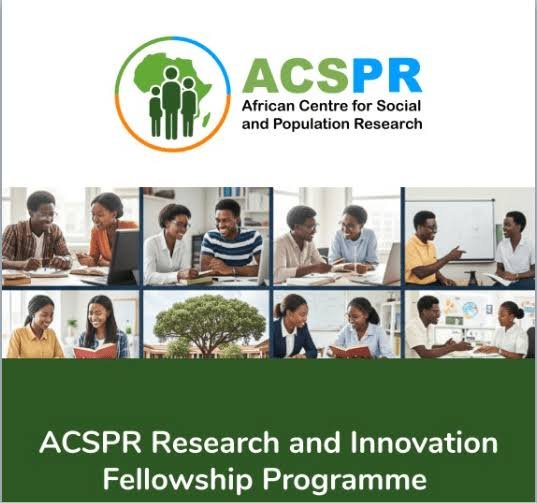
ACSPR Research and Innovation Fellowship programme (ACSPR-RIF)
ACSPR Research and Innovation FellowshipProgramme (ACSPR-RIF)
Call for Applications
The African Centre for Social and Population Research (ACSPR) invites applications for the ACSPR Research & Innovation Fellowship Programme (March–August 2026) – a six-month capacity-building and applied research fellowship designed to develop future-ready African research leaders who can translate evidence into action.
About ACSPR
ACSPR is a non-profit, non-partisan research and development organisation dedicated to advancing understanding of population dynamics and social change across Africa. We generate rigorous, interdisciplinary evidence and partner with governments, civil society, academia, and communities to strengthen policies, institutions, and community outcomes especially for vulnerable and marginalized groups.
Key focus areas:
- Population and Demographic Research
- Education and Skills Development
- Health and Well-being
- AI, Data, and Digital Governance
- Climate, People, and Planet
- Humanitarian Response and Resilience
About the Fellowship
The ACSPR Fellowship Programme is an intensive six-month capacity-building and applied research programme for early-to-mid-career African researchers, practitioners, and policy enthusiasts. It is not only training, it is an immersive, mentored experience where fellows work on real ACSPR programmes/projects and develop practical research or innovation outputs aligned with ACSPR’s focus areas.
Fellows will strengthen competencies in:
- Research design and implementation (qualitative, quantitative, mixed methods)
- Data management, analysis, and visualization
- Ethical research practice, safeguarding, and do-no-harm
- Knowledge translation, policy engagement, and communications
- Responsible data use, digital governance, and AI-for-development concepts (where relevant)
Duration: March 2026 – August 2026 (6 months)
Time commitment: 8–12 hours per week (part-time)
Why this Fellowship Matters
Across Africa, decision-making is increasingly expected to be evidence-driven, inclusive, and digitally enabled yet gaps persist in structured mentorship, applied research opportunities, data and analytics capacity, knowledge translation, and the responsible use of digital tools for public good. This fellowship responds by building practical, ethical, and locally grounded research leadership, aligned with the SDGs, the UN Pact for the Future, and Africa’s national and regional priorities on youth empowerment, inclusion, climate resilience, and accountable institutions.
Fellowship Tracks / Streams
Applicants may indicate one preferred track (and an optional second choice):
1) Research & Policy Track
Applied research, policy engagement, and evidence translation.
Typical outputs: research tools/protocols, report sections, policy briefs, stakeholder packs.
2) Data & AI Track
Data management, analysis, visualization/dashboards, and responsible AI concepts for development.
Typical outputs: cleaned datasets/codebooks, analysis memos, dashboards/prototypes, data/AI ethics notes.
3) Communications & Knowledge Translation Track
Public-facing writing, storytelling, packaging evidence, and dissemination.
Typical outputs: blogs/explainers, infographics, brief packaging, dissemination plans.
4) Operations & Partnerships Track
Coordination, stakeholder engagement, and proposal/programme support.
Typical outputs: stakeholder maps, coordination trackers, partner meeting notes, proposal components.
Note: To ensure consistent quality across diverse tracks, all fellows regardless of stream will participate in a set of core seminars covering: research ethics and safeguarding, research in African contexts, evidence-based programming, data literacy, and knowledge translation. Track-specific sessions will then build advanced competencies relevant to each stream.
Eligibility Criteria (Minimum)
Applicants must:
- Be a citizen of an African country and residing on the continent.
- Demonstrate interest in social research, population studies, public policy, health, education, climate, humanitarian response, or digital governance.
- Be an early-career professional, final-year undergraduate, postgraduate student, or recent graduate (preferred).
- Demonstrate commitment to ethical research and community engagement.
- Submit a concept note (approx. 500 words) aligned with one ACSPR focus area. The concept note should demonstrate the applicant’s research interests and problem-solving approach and may form the basis of the fellow’s project work during the fellowship, subject to ACSPR priorities, mentorship guidance, feasibility, and ethical considerations.
- Be proficient in English.
- Have reliable internet access and a computer for virtual sessions.
- Be able to commit time consistently throughout the fellowship (8–12 hours/week recommended).
Note: Selection will be competency-based (skills, portfolio, concept feasibility, and commitment), not only academic qualifications.
What Fellows Will Gain
Fellows will receive:
- Practical training across research, data, policy, and innovation
- Mentorship from ACSPR staff and affiliates
- Participation in real projects with opportunities to contribute to publications (subject to contribution and review)
- Access to ACSPR tools, templates, and learning resources
- Fellows will receive structured opportunities to showcase their work through ACSPR platforms, including Fellows Spotlight features, newsletter highlights, blog publication opportunities, and dissemination of approved outputs through ACSPR’s website and social media channels.
- Membership in a growing alumni network and community of practice
Funding note: Any stipends, research facilitation support, travel/fieldwork costs, or software access are subject to funding availability and donor conditions and will be communicated clearly to selected fellows.
Fellowship Outputs & Expectations (Summary)
Fellows are expected to:
- Participate actively in trainings and mentorship sessions
- Maintain professional conduct and comply with safeguarding and data protection requirements
- Contribute to at least one programme/project deliverable
- Publishable Article: Each fellow will produce one well-researched article (blog-style or commentary/insight piece) based on their fellowship work, to be considered for publication on the ACSPR website/blog subject to editorial review and approvals.
- Present work during midline and endline learning events
All public outputs will follow ACSPR quality standards, ethics, and publication approval processes.
Application Package (Required Documents)
Applicants must submit one combined PDF containing the following (in this order):
- Completed application form
- CV (max 2–3 pages recommended)
- Motivation statement (500–800 words)
- Concept note (approx. 500 words) aligned to one ACSPR focus area
- Two referees (names and contacts)
- Optional (track-based): writing sample / portfolio / code sample
Submission note: Please upload all documents as one PDF file (single attachment).
Selection Process
Applications will be assessed through a structured process that includes eligibility screening, scoring, and (where necessary) interviews or a practical task.
Shortlisted applicants may be invited for a virtual interview and/or a brief practical task.
Key Dates (Insert your final dates)
- Call opens: 10th February 2026
- Application deadline: 28th February 2026
- Shortlisting & interviews: 2nd – 5th March 2026
- Notification of results: 10th – 12th March 2026
- Fellowship starts: 16th March 2026
- Fellowship ends: August 2026
Equal Opportunity Statement:
ACSPR is an equal opportunity organisation. We welcome applications from all qualified candidates regardless of gender, disability, ethnicity, religion, or socioeconomic background. Selection will be based on merit, programme fit, and commitment to ethical and inclusive practice. We particularly encourage applications from women, persons with disabilities, refugees, and individuals from marginalized communities.