2026 Pan-African Policy Challenge for Undergraduate Students Across Africa
2026 Pan-African Policy Challenge for Undergraduate Students Across Africa
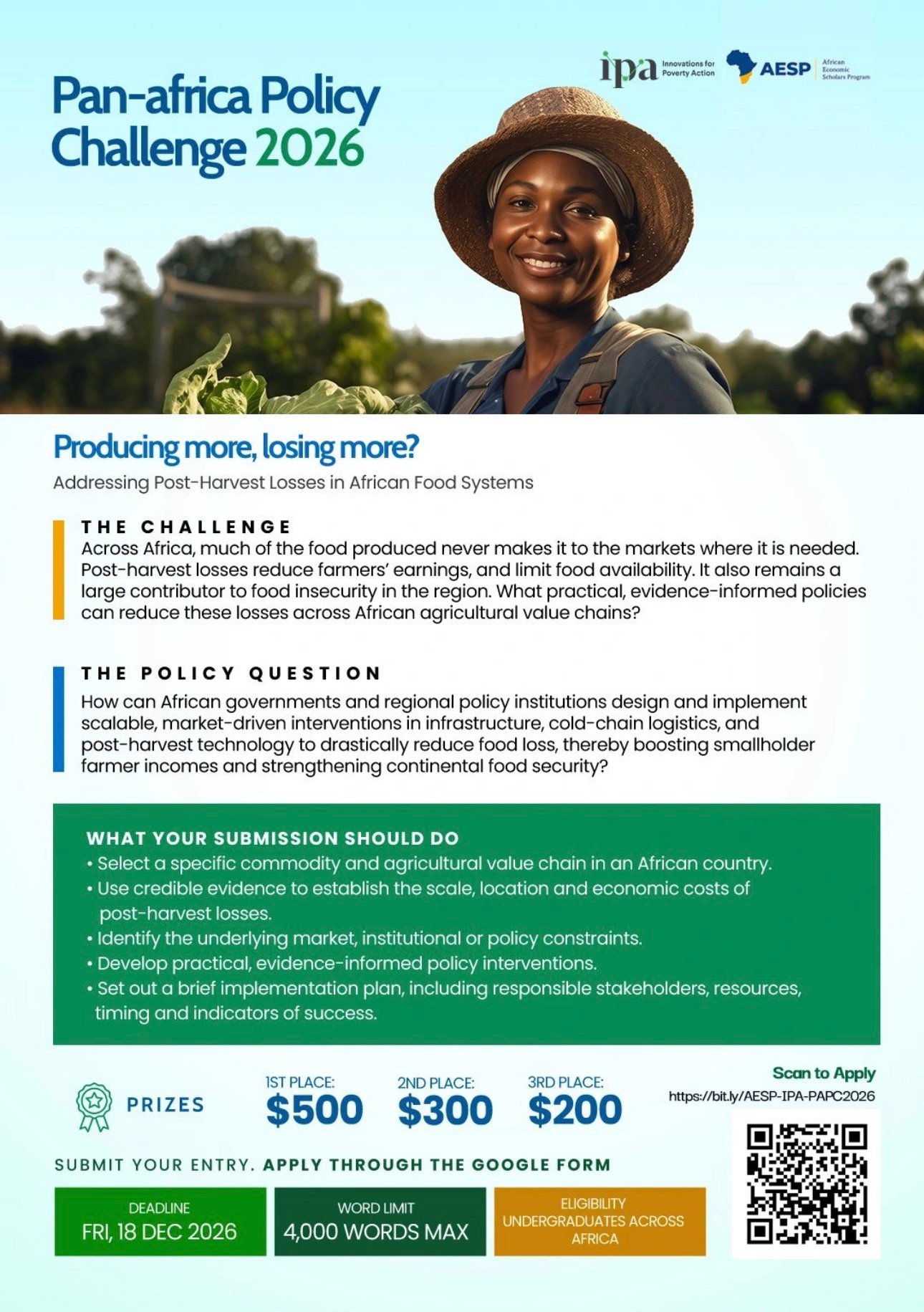
The African Economic Scholars Program (AESP), in partnership with Innovations for Poverty Action (IPA), invites applications from undergraduate students across Africa for the 2026 Pan-African Policy Challenge.
The competition provides an opportunity for young researchers and aspiring policymakers to develop evidence-based policy recommendations addressing critical challenges in Africa’s agricultural sector.
Challenge Title: Producing More, Losing More: Addressing Post-Harvest Losses in African Food Systems
Organisers: African Economic Scholars Program (AESP) and Innovations for Poverty Action (IPA)
Location: Open to eligible undergraduate students across Africa
Eligibility: Undergraduate students enrolled at recognised African universities
Prize: Cash prizes of up to $1,000
Application Deadline: Friday, 18 December 2026
About the Policy Challenge
The 2026 Pan-African Policy Challenge focuses on reducing post-harvest losses in African food systems.
Although agricultural production remains a major part of Africa’s economy, significant quantities of food are lost after harvesting due to inadequate infrastructure, poor storage facilities, limited cold-chain logistics, weak market coordination and insufficient access to post-harvest technologies.
These losses reduce the quantity and quality of food reaching markets, lower smallholder farmers’ incomes and contribute to food insecurity.
Through this challenge, AESP and IPA aim to encourage undergraduate students to develop practical, evidence-based and scalable policy solutions that can help African governments and regional institutions address these problems.
Core Policy Question
How can African governments and regional policy institutions design and implement scalable, market-driven interventions in infrastructure, cold-chain logistics and post-harvest technology to drastically reduce food loss, increase smallholder farmer incomes and strengthen food security across Africa?
What Participants Are Expected to Investigate
Applicants are expected to develop a policy submission addressing the following six components:
1. Selection of Commodity and Value Chain
Identify a specific agricultural commodity and its value chain in an African country where post-harvest losses are significant. Explain why you selected the commodity and its importance to the country’s agricultural sector.
2. Scale of the Problem
Use credible evidence to establish the proportion of the selected commodity lost, where the losses occur and their economic consequences. General statements about food waste are insufficient; submissions should provide relevant data.
3. Underlying Causes
Explain why post-harvest losses persist. Consider factors such as inadequate infrastructure, limited access to finance, weak market coordination, insufficient information, regulatory constraints and other relevant challenges.
4. Role of Policy and Markets
Examine why farmers, traders and private businesses have not adequately addressed the problem. Identify where government intervention is necessary and where private investment could provide more effective solutions.
5. Practical Policy Intervention
Propose specific, feasible and evidence-informed policy interventions to reduce post-harvest losses. Explain how the proposed solutions would work, the institutions and stakeholders responsible for implementation, the resources required, and the likely costs and benefits.
6. Implementation Plan and Expected Results
Develop a practical implementation plan identifying responsible institutions, stakeholder roles, required resources and realistic timelines. Also identify possible implementation challenges and measurable indicators for evaluating progress and expected outcomes.
Submission Requirements and Guidelines
All applicants must observe the following requirements:
- Submissions must be written in English.
- Entries must not exceed 4,000 words, excluding references and preliminary pages.
- Only PDF documents will be accepted.
- Submissions must be made exclusively through the official application form.
- Entries must address all six required components outlined in the challenge guidelines.
- Claims and recommendations must be supported by credible evidence, including official statistics, agricultural surveys, academic research and policy evaluations.
- Applicants should clearly distinguish established findings from assumptions and acknowledge limitations in available data.
- AI-generated or plagiarised submissions will be disqualified.
Advanced econometric analysis is not compulsory. However, participants are expected to demonstrate strong economic reasoning, relevant evidence, realistic policy recommendations and an understanding of how proposed interventions can be implemented and evaluated.
The top 10 finalists will be contacted and invited to present their policy ideas.
Prizes
Selected participants will have the opportunity to receive cash prizes of up to $1,000.
The challenge also provides undergraduate students with an opportunity to engage with important African policy issues and contribute ideas that can inform practical policy decisions.
Related Posts
FAO INTERNSHIP PROGRAMME 2026/2027 FOR STUDENTS AND GRADUATES
UNDP NORTHEAST COMMUNITY INNOVATION CHALLENGE 2026
How to Apply
Interested and eligible undergraduate students should carefully review the detailed challenge brief and prepare their policy submissions according to the stated guidelines.
Important Dates
- Application Deadline: Friday, 18 December 2026
- Top 10 finalists contacted: To be communicated by the organisers.
Enquiries
For further information, contact:
Email: aesprogram2023@gmail.com
Interested undergraduate students across Africa are encouraged to review the challenge brief and submit evidence-based policy proposals before the deadline.